For many, conflict resolution, resource management and economic planning might not appeal, for others they’re the ideal ingredients for the perfect game. Rather than hone pixel perfect reactions, these players love to exercise their grey matter with problem solving, lateral thinking, and analytics.
These are some key pillars of the strategy game genre.
Whether you’re into hyper-realistic management sims, grand strategy, CCGs or turn-based tactics, the strategy genre offers a diverse, constantly evolving landscape for players to dive into.
At Sumo, our resident experts in the strategy genre are Lab42. Having worked on a range of own-IP strategy games alongside a plethora of co-developed and ported strategy titles, Lab42 have some interesting insights to share as to how to make a good strategy game.
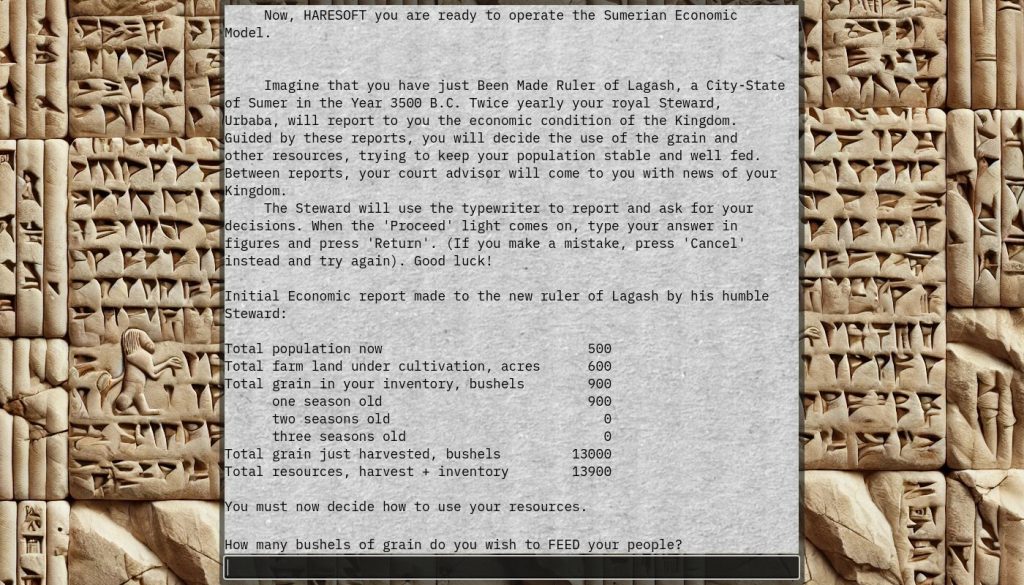
[Image credit: Haresoft. A screenshot from 1963s The Sumerian Game – which is widely considered to be the games industry’s first foray into strategy game development. Lost to time, this archive game was restored in 2024 and made available to play for free on Steam.]
A HISTORY OF STRATEGY GAMES: Looking to the Past for Inspiration
Strategy video games have a certain pedigree, drawing inspiration from ancient real-world games like Senet [est. 2620 BCE], The Royal Game of Ur [est. 2600 – 2400 BC], Go [est. 548 BC] and Chess [est. 1475].
These marvels of game design pit players against each other in a competitive, combative environment, providing a definitive ruleset in a constrained space. The flexibility of the rules created games that required strategic thinking and long-term planning to succeed.
Predating traditional video games, The Sumerian Game was created in the 1960s as part of a research project to test the use of computer-based simulations in schools. This text-based strategy game might have been rudimentary in design, but its resource-management and economic simulation was pioneering laying the groundwork for strategy games today.
The earliest ‘official’ recorded strategy title for home console was Invasion, a Risk-like, digital boardgame, which tasked players with capturing opposing enemy castles while protecting their own.
Whilst many new strategy titles were released over the subsequent two decades, it’s widely thought that 1992’s Dune II, released by Westwood Studios and Virgin Games, was the game that cemented the format of strategy games, and popularised the genre for the future.
Dune II brought not only big sales for the genre (it’d shifted 250,000 copies by November 1996), but innovated with a fog-war system, a fluid and responsive mouse and keyboard control system and a perfect balance between complexity and innovation in its gameplay.
Fast forward to today and this formula still resonates, highlighted by the burgeoning number of successful strategy games.
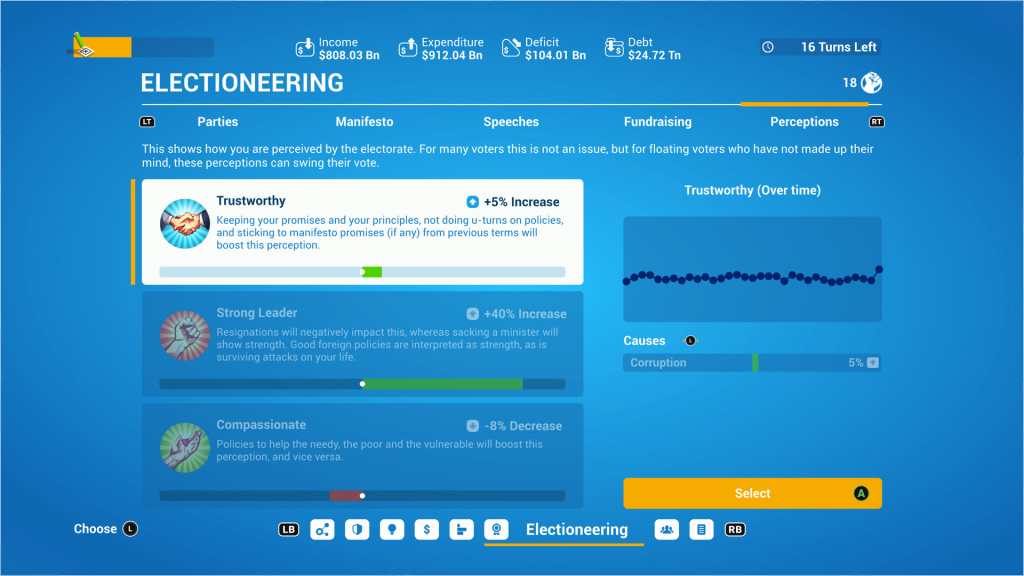
[In Democracy 4, players take on the role of a world leader, making decisions about the future of their country, impacting public opinion, the economic climate and likelihood of re-election.]
WHY WE LOVE STRATEGY GAMES: Thoughts from Behind the Curtain
For many, picking up a video game is an escape from the daily grind, a way to relax in far off worlds, hear compelling stories, or just enjoy some casual adventures with friends. For others, they crave the mental stimulation of routine, rules and numbers of strategy games.
So why do players seek solace in these kinds of taxing experiences? Joao Pereira and Dylan Samara (Game Designers at Lab42) are here to share their thoughts.
Measured Progress: “Strategy games are a great way to see your own improvements and development in real-time. Often, a strategy game will give you a challenge that might seem impossible but, with enough practice, time and experimentation, can be mastered by the player. This feeling of accomplishment is satisfying and there’s nothing like seeing a well-thought-out plan yield good results!” – Joao
Joao is a lifelong strategy game fan and was part of the team who worked to bring Paradox Interactive’s acclaimed title Crusader Kings III to console in 2021.
Player Agency: “Crusader Kings is great at putting the player in full control right from the start. It offers a brief introduction to the basic game mechanics, then leaves it up to the player to find the rest of the information they need. This is a great way to appeal to a wide range of playstyles and adds to its replayability as you become more knowledgeable and experienced.
“I’ve had saves of Crusader Kings III where I’ve gone for brute force to overturn and succeed the monarchy on one hand then I’ve also had attempts where patience and diplomacy are central to my successful strategy. Only through trying different approaches was I able to master the game and its systems. This mastery and choice is at the core of a successful strategy game.”
Strategy games are also extremely versatile in their theme and appearance, sitting equally comfortably in a realistic time period or in a completely fantastical world.
Game Setting: “Ultimately, it comes down to what kind of fantasy a player is looking to fulfil. Are they looking to embody a great ruler conquering Europe, to blast off into space and harvest resource from Mars, or are they simply looking to manage a highly successful theme park filled with cool rollercoasters?”- Joao
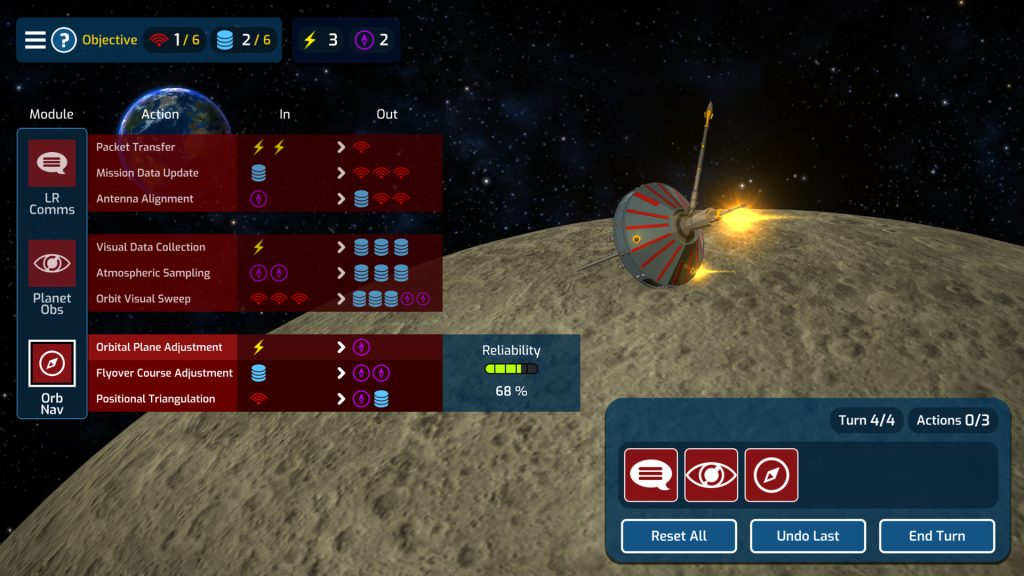
[Mars Horizon. Good UI/UX is critical to making a successful strategy game. Keywords, icons and menu styling make a huge difference conveying information.]
ACCESSIBILITY AND USER EXPERIENCE: Communication in Strategy Games
Strategy games by their nature can be incredibly complex, with multiple gameplay mechanics and management systems running at any time. To give players the best chance of success, they must convey large amounts of information succinctly and clearly. Information must be readable, accessible and clear, with any introduction of new data paced in such a way to avoid players getting overwhelmed, and ultimately missing crucial details.
UI/UX “Keywords, videos or icons are all great ways to lessen walls of text and present information concisely and efficiently. There are snippets of information that can be delivered through Tooltips throughout the game, which provide essential details without cluttering the screen with heaps of text. By having them respond to a cursor or control hover, they offer the player the opportunity to access the information rather than forcing them to read it.”- Dylan
“Once you’ve identified what is crucial info for your game, you can introduce beginner scenarios or tutorials. Whilst these aren’t unique to the genre, strategy games are given a unique challenge of having to get players to experiment and explore, and get them into habits of learning the complexities, where information is stored should they need it, and how the mechanics work.” – Joao
“Players always learn better through repetition. If you’re able to efficiently teach them how a mechanic works by first showing them and then making them repeat it a few times, they’ll be able to recall this series of actions for the future.”- Dylan
“There are some very good examples of how to achieve this in existing strategy games, with some of these universal principles approached in a number of creative and interesting ways. Developers of strategy games have the advantage that strategy players expect a high level of text and information, this however doesn’t mean we should take their time or attention for granted.” – Dylan
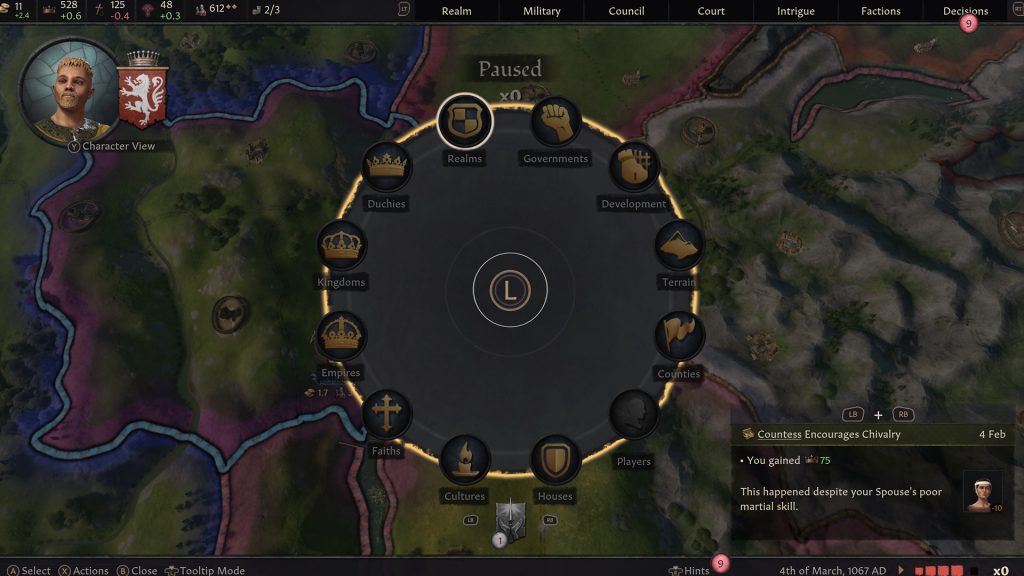
[Crusader Kings III: Console Edition. Radial menus are a great way to give players an easy-to-navigate system that conveys key information through icons and keywords. Making information easy to find and accessible.]
STRATEGY POPULARITY: Bringing Strategy Games to Broad Audiences
Most often, a strategy game will release for PC before other platforms. The capabilities of gaming PCs, the precision of a mouse and keyboard and the screen size are all contributing factors into why PC is the #1 platform for games in the genre.
But when it comes to taking those games and bringing them to console or mobile, all of these PC-specific features need to be reconsidered. Here Joao and Dylan share some of their top tips for porting strategy games.
Controls: “Mouse and keyboard controls offer precision and a wider range of inputs compared to a controller. When you’re porting any game, particularly a strategy game built for point and click controls, it’s important to test new setups with pad in hand.
Critically on pads, the limited buttons require easy ways to switch functionality and very responsive analogue sticks for maximum control. Keep it consistent, every player deserves to feel like the platform they’re using is the best.” – Dylan
Menus and Layout: “When porting a game from PC to console, it’s important to consider their home setup. For PC, they are likely in close proximity to the screen, whereas the TV is much further away. You have to ensure that players can clearly read icons, menus and tooltips from further away, whilst still being able to navigate around the screen quickly and accurately.
For Crusader Kings III, we grouped vertical menus together into radial menus to improve usability and readability. This helped to de-clutter the HUD hugely. By having two radials, character and map, players could quickly and easily find the information required.” – Joao
OUR FAVOURITE STRATEGY GAMES: Cult Classics
If it isn’t obvious, these two love strategy games. Whether it’s the challenge of creating one, or the mastery of playing one, they are bursting with passion for this genre and are thrilled to share some of their favourites.
“Not all games are able to engage, challenge and reward their players in the same way as strategy games can. By keeping me constantly thinking and planning about my next move, strategy games are really rewarding to both play and work on”. – Dylan
Total War: Warhammer III: “When it comes to real-time simulator games, the Total War franchise has some of the best. Combining turn-based strategy and economy control with real-time battles on a huge scale, plus a fantasy setting, Warhammer III is one of my all-time favourites”. – Dylan
Magic the Gathering: “Both the online and physical versions of the game offer a highly customisable experience with limitless possibilities. I’m relatively new to the game, but I love creating new decks centred around a theme or mechanic, like ninjas or resurrecting creatures from a graveyard”. – Dylan
“The sense of exploration, experimentation, learning and mastery is what keep me returning. The ability to create emergent stories using the game’s systems and mechanics offer high-replayability, and makes every run feel unique.” – Joao
Crusader Kings III: “This grand strategy game boasts deep systems and mechanics allowing for completely customised play-thoughs. This tailored experience means I can have ‘serious’ sessions with clear objectives, or ‘goofy’ sessions where I can experiment and have fun with outlandish scenarios.” – Joao
XCom/XCom 2: “Dramatic turn-based combat, squad variation and the peril of every encounter offer endless experimentation and gameplay outcome. It’s a masterclass in emergent storytelling, emphasising the crushing sense of disappointment when my team is decimated by a hoard of chrysalids.” – Joao
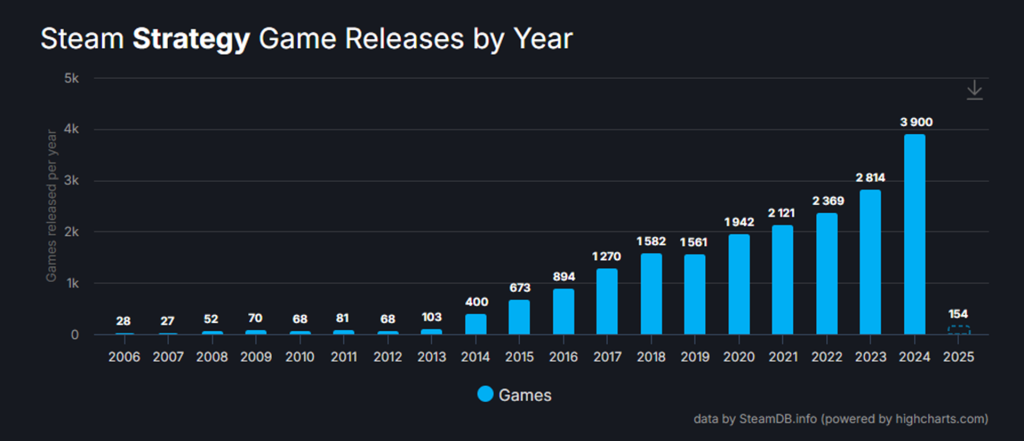
[Screenshot taken January 2024. Strategy games releasing on PC have been steadily increasing over the last 19 years, and 2024 was a bumper year for launches in the genre.]
THE FUTURE OF STRATEGY GAMES: Going from Strength-to-Strength
A 2024 report from Quantic Foundry found that gamers have become less interested in strategic thinking, with a decreasing trend line for strategy being a key audience motivator. As player’s attention spans shorten, more people are seeking out shortform disposable content which is opposed to traditional games in the strategy genre.
Strategy games are renowned for their large size and scope and if we look at the top-selling strategy games from the last five years [according to Strategy & Wargaming], they take around 90 hours to complete on average. In a recent report, Statista estimated that the global average for # of hours spent gaming each week was 8.45 – which would mean it would take the average gamer 10 weeks to see their strategy game to completion.
Surely then, a decreasing appetite for longform content would imply fewer strategy games? Well, no. According to SteamDB, almost 4,000 games tagged with ‘strategy’ were released in 2024, excluding sub-categories, up 1000 releases from 2023 and almost double that of 5 years ago.
And strategy games show no sign of slowing in 2025, with key titles already climbing their way up the Steam wish-list charts, including the hotly anticipated Sid Meier’s Civilization VII, espionage grand strategy game Espiocracy, galactic strategy simulation game Mars Horizon 2 and cinema studio simulator Hollywood Animal.
Developers all over the world are hard at work on bringing their next strategy game to life, and we’re looking forward to seeing how they take the genre to the next level.