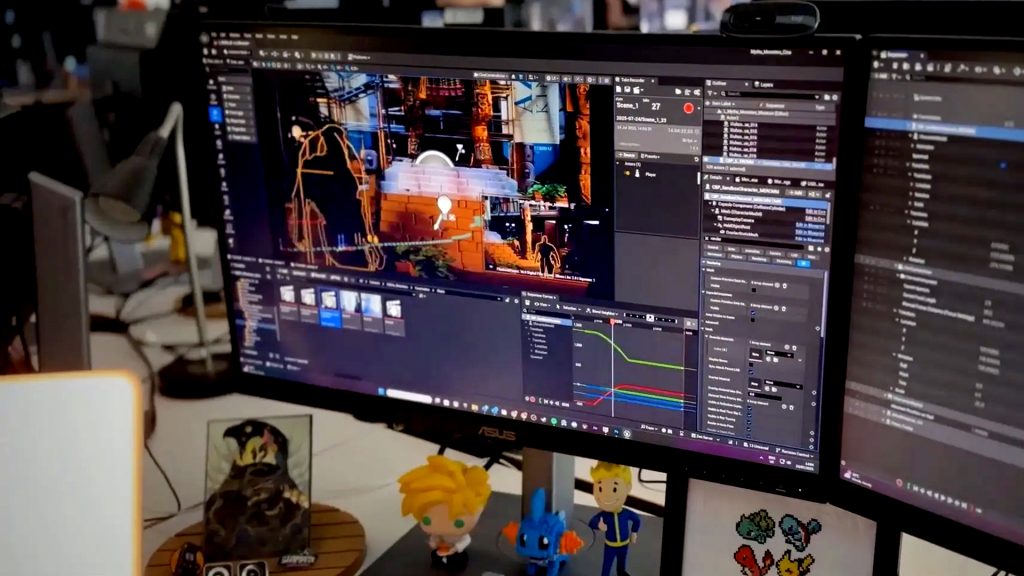

Red Kite Games has collaborated with some of the biggest franchises in the industry, not only contributing to brand-new titles, but also bringing beloved games of yesteryear back for modern audiences in the form of remasters.
But how does a studio approach a remaster game project? And how can the preparation differ from working on an original IP?
Red Kite Games’ Technical Director Andy Greensmith and Programmer Dave Smith explained how it all works.
THE CHALLENGE OF REMASTERS: Where to Begin
“When starting work on remastering a game you have to start with the original. A good place to start is to look at the original game’s systems and work out what needs improving. Something that can’t be overlooked is looking at what people loved about the original game.”
“For example, if there’s a very popular gameplay element that could be improved with modern technology and tools, should it be?”
“The key difference between a remaster and original IP would be that all the principal design decisions, themes, aesthetic, and story are already set and (mostly) immutable,” said Dave. “The problem shifts from ‘How do I create a great game?’ to ‘How do I translate a great game for today’s audiences, while preserving all that made it special.”
“These challenges are why we love to make games.”
“Remastering or remaking a game can be challenging,” said Andy. “Fans already have an expectation of the game because they are fans of the original”.
“Remastering a game is somewhat like taking a classic car that is beloved by many and installing modern parts. The challenge is figuring out the right balance between tuning up the original version vs changing and upgrading so much of it that it’s unrecognisable.”
UNDERSTANDING THE AUDIENCE: Player Expectations
“Players often look back on fond memories with rose-tinted spectacles. What once may have been hailed as an industry-leading graphical masterpiece, may no longer look that way, but in the minds of the original fans, it still is perfect. Therefore, it is vital to hit those same notes again, but in an industry that is far more advanced.
“Not only that, there also needs to be a balance struck between updating the gameplay, with the nostalgic memories and ‘feel’ of the old experience.”
“It’s quite a difficult rope to traverse across!”
Old gameplay systems may feel clunky and outdated but updating these in subtle ways can vastly throw off the feel and experience the original delivered.” - Dave
REWARDS OF THE REMASTER: IP Guardianship
Managing a remastered game can be a somewhat daunting task. Here Andy and Dave highlight why the team at Red Kite Games are eager to get involved.
“It can be very challenging but also very rewarding. With a remaster you can bring old fans of the game back and hopefully give them that sense of awe and wonder they had when playing the game for the first time. It can also be rewarding because you are introducing an entirely new generation of players that missed playing the original.”
“Many of us at Red Kite grew up with Mafia and God of War defining our childhood and teenage years,” said Dave. “To work behind the scenes of worlds that gave us so much joy in our naive youth is both exciting and enlightening.”
“With God of War III: Remastered, one of the elements we needed to update was the audio,” Andy adds. “With an original game, you can record voiceover and develop new sound effects to fit any situation. But with a remaster you’re somewhat confined to the sound design of the original game.
“Players will know exactly what sound Kratos makes when he takes damage or swings the Blades of Exile, so if you change a lot of those people may compare and contrast it negatively to the original. Our approach, knowing this, was to upgrade and enhance the sound of the original game, not only for a new game but for a new generation of consoles.”
PLATFORM SPECIFICITY: Working with New Technologies
A major project that people will no doubt have heard of, is Red Kites development of Mafia III: Definitive Edition, bringing stunning 4K visuals and enhanced gameplay to 1960s New Bordeaux.
We asked Andy and Dave to tell us more about this individual project, and the key moments that stood out during its development, including developing for a cloud-based gaming audience.
“With Mafia III: Definitive Edition, we were given the opportunity to be one of the first video game studios in the UK to develop for Google Stadia,” said Andy. “With this project not only were we working to remaster games from Mafia, a critically acclaimed franchise, but we were also developing it for a brand-new platform.
“With Stadia being such cutting-edge technology, perhaps bleeding-edge at the time considering it had not yet been announced, we were blazing a trail,” said Dave. “Developers are typically able to rely on a repository of forums, discussions, and lessons that fellow colleagues within the industry participated in. Instead, we had all the joys of exploration and discovery, boons and frustrations alike.
“Two of the major hurdles for Mafia III: Definitive Edition were porting the entire engine over to a Linux-based OS and getting the renderer to run off Vulkan. After some months of effort, seeing the menu screen pop up for the first time on Stadia was monumentally exciting.
“Likewise, when we first loaded into a test level. While we still had a lot of work to do, and performance improvements to make, it was the first tangible example of our efforts.”
We’ve seen first-hand from Red Kite Games’ remastered titles that there are various factors to consider. Mafia: Definitive Edition gave the game world a new lease of life with realistic visuals and provided new mechanics, while God of War III: Remastered focused on maintaining the ambience experienced in the original, but with greater effect.
THE IMPACT OF TECHNOLOGY: Advantages of modern consoles
Gamers these days are fortunate to have hugely powerful game consoles to play on, with PlayStation 5 and Xbox Series X|S dominating the market. We ask what are the advantages for developers working on current-gen platforms and how may that further develop with next-gen software such as Unreal Engine 5?
“Current gen consoles like the Xbox Series X|S or the PlayStation 5 have so much raw power and memory available to developers, compared to the previous generation,” said Andy. “This means that as a developer you have so much more room to implement detailed textures, lighting effects, uncompressed sound and so much more.
“New game engines like Unreal Engine 5 have revolutionary technology like Nanite Virtualised Geometry which gives increased geometric complexity and higher triangle, and object counts. These technologies mean we can develop games that look, sound and play better than ever before.”
CRITICAL RECEPTION: What makes a good remaster?
NOSTALGIA: “A good remaster should give players the same feeling they had when they first played the original,” explains Andy. “When they boot it up and see the main menu and the opening cut scene, they should get that warm feeling of nostalgia that takes them back to when they were younger.
AUTHENTICITY: “A facet of remasters that players may overlook is the ‘Rose tinted glasses’ that players have for their cherished favourites. Players might not remember the games they played when they were younger had flat textures or lower quality sound effects than would be expected of a modern game.
“It’s quite a complicated problem to solve. How do you deliver the same impact, today?”
Of course, Andy and Dave won’t spoil any surprises, but we asked if they saw remastered games playing a fundamental part in Red Kite Game’s future when looking at new projects.
PASSION: “We’ve loved working on remaster projects like God of War III and Mafia: Definitive Edition,” said Andy. “Seeing the overwhelmingly positive response from players, whether they were big fans of the original or picking up the game for the first time, is so important to us.”
“We love to make games and solve problems,” said Dave. “Remastering games introduces unique challenges that are fun to tackle. We can absolutely see remastered games factoring into our future.”